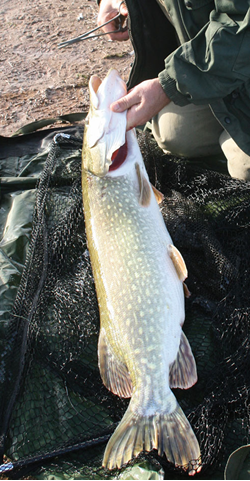
Recommended Code Of Conduct fo Pike Handling
Environment
Please refrain from causing any damage to crops, fences, or trees, and ensure that you do not leave any litter or tackle behind. If you happen to come across any items left behind by other anglers, please take them home. It is important to always show respect for the environment and its wildlife, as discarded litter or tackle reflects poorly on all anglers. Unfortunately, there are certain groups of anglers who have adopted a trend of behaving in a manner that causes annoyance to others. As pike anglers, it is crucial that we do not participate in such behaviour. Always check with the landowner, fishery or club that they allow things like bivvies, night fishing, BBQ’s and fires, braid and trebles etc. before proceeding, never assume.
Warm Water Piking
Research indicates that pike experience suffering and may perish when caught in warm water temperatures above 18 degrees. We advise against fishing for pike when water temperatures exceed 18 degrees.
Respect
The esteemed reputation of the BAA and the respect it has garnered has taken many years to establish. However, irresponsible actions by one or more members have the potential to undo all the hard work in a matter of minutes. The name of the BAA is entrusted to each and every member, as all members are representatives of the BAA. It is important for you, as a member, to uphold the BAA’s reputation by closely adhering to the recommendations listed here.
Tackle
Please ensure that you have the appropriate gear required for pike fishing. The gear should be strong and reliable, and it should include the following items: •
A large knotless landing net (42+ inch triangle net or a suitable equivalent oval net, such as 85cmx70cm).
A large unhooking mat / cradle and a large weigh sling (combined mat/slings are available to reduce handling).
Long forceps or long nose pliers (minimum length of 10 inches).
Wire cutters.
Wire traces (minimum 30lb for bait fishing) with a length of 18 inches or more. It is also good practice to use an 'uptrace' when bait fishing. BAA does not endorse the use of mono or fluorocarbon traces. Shorter traces are acceptable for lure fishing and live baiting with an uptrace.
Ensure that you have proper bite indication while bait fishing. Use a bite indicator, drop off indicator, front and/or rear bite alarms, or float. Do not free line.
Please use a mainline that is appropriate for the venue and conditions. We recommend using 18lb monofilament and 50lb braided line as a good all-around guideline. It is advisable to use heavier braided line for large lures and for ensuring that you can straighten hooks to retrieve the end tackle.
Carry scales and appropriately large weigh slings.
Leads should preferably be fished on a weak link so that they will break away if snagged, avoiding the loss of a baited rig.
It is preferable to use semi-barbless or crushed barbed hooks in sizes 4 to 6, as this will prevent fish from escaping. However, using semi-barbless hooks should not be an excuse for allowing a pike to swallow the bait. The hooks should be strong enough to land a large pike but not excessively strong that they will bend out if you become snagged.
When boat fishing, always wear a life jacket.
Baited Rods
You should never leave your rods unattended under any circumstances. Always ensure that you are within a reasonable distance of your rods. If you choose to leave your fishing spot for any reason, reel in your line. It only takes a few seconds for a pike to swallow a set of hooks. It is unfair to ask or expect another angler to watch over your rods while you are away. They have their own fishing equipment to manage, and while they are looking after your rods, their own unattended baits could be devoured by a pike.
Baiting Traces
It is crucial to properly position the hooks in the bait to minimize the likelihood of deep hooking. For most live baiting, place the top hook in the dorsal area and the other hook behind the pectoral fin. For legered dead-baits, place the top hook in the tail root and the other hook no further forward than the dorsal fin.
Hitting Runs
Never wait for a second opportunity. Strike as soon as you have an indication of a run. Although conditions may vary, it is better to strike sooner rather than later. It is preferable to miss a pike than to hook it deeply. Remember, deeply hooked pike not only suffer damage from the hooks but also from the extra time it takes to return them to the water. MINIMUM HANDLING = MAXIMUM CONSERVATION.
Pike Welfare
Please handle all Pike with the utmost care. When unhooking, please lay it on an unhooking mat or cradle, never on uncovered hard ground. When fishing from a boat, it is preferable to use specialist fish care equipment such as specialist boat unhooking mats such as a 'sladle' or similar. Never use a Pike gag when unhooking. Instead, please use the forceps and hand technique. Lay the pike on its back and firmly hold its lower jaw (through the gill cover, avoiding the gill rakes) with one hand, while removing the hooks with the other. Always be especially careful when you find it necessary to insert the forceps behind the gill covers. At all times, make sure the fish is held firmly.
Weighing
Weighing should be carried out using a weighing sling or combi mat / sling - NOT with the balance hook under the chin. Boga Grips SHOULD NEVER be used to assist in holding or unhooking pike!
Retaining Pike
Pike should not be kept for extended periods or in carp sacks. Large flotation slings, purpose-built pike tubes, and landing nets themselves are appropriate for temporarily keeping pike. The duration of this period is to allow the pike to recover before being released, or while you prepare your photography, unhooking and weighing equipment, or if you need assistance from a nearby angler, etc. Always make sure that the fish has fully recovered before releasing it, supporting it by hand or with the net until it is ready to swim off strongly.
Live Baiting
When engaging in live baiting, it is recommended to use bait no longer than 8" (20 cm). The transportation and subsequent translocation of live bait from one body of water to another is considered an offense throughout the British Isles and should NOT be practiced. Live baiting is prohibited in Scotland and Ireland. It is crucial to ensure that live baiting is an acceptable and legal method in the body of water where you are fishing. Always remember that using large baits not only presents hooking problems but also increases the likelihood of displeasing pleasure and match anglers. It is important to always exercise tactfulness when live baiting.
Incidents
If you happen to witness anyone mistreating pike, please make an effort to persuade, educate, and convince them that there is no justification for such behaviour. It is important to remain calm and composed, even if they refuse to listen. If the situation does not improve, it is advisable to leave and report the incident to the fishery owner and your Regional Organiser.
Incidents of poaching should be reported to the Police through the National non-emergency number of 101 or through the Environment Agency report line of 0800 807060. Use this number also to report any pollution issue.